What Happens at the Akiya Closing Process in Japan
By Minseon
The Day You Become the Owner
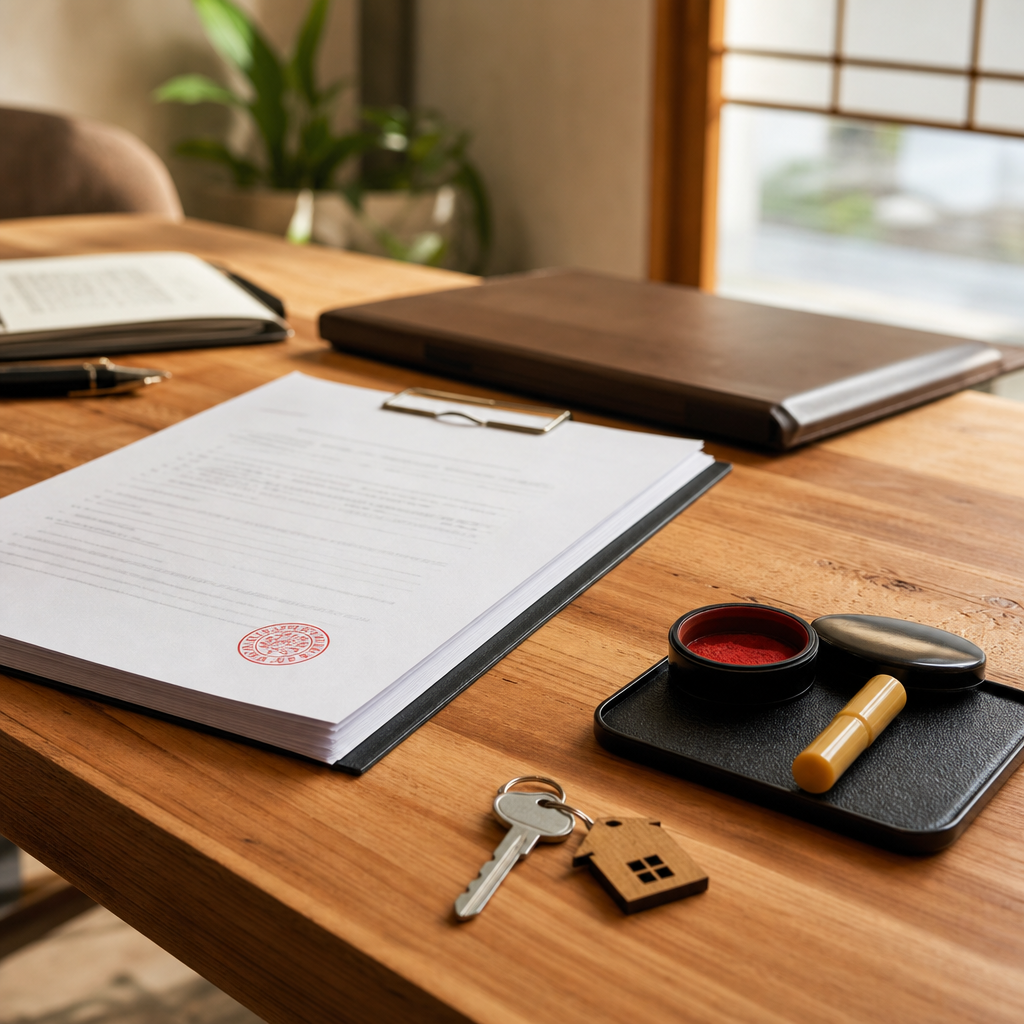
After months of searching, negotiating, and paperwork, closing day feels anticlimactic. You’re in a small office, surrounded by documents you can’t read, and signing things with a stamp you’ve only used a handful of times.
That’s how it felt for us, at least.
The Japanese real estate closing process — called shūkan (周旋) or more formally the jūtaku no torihiki — is formal, procedural, and designed for people who have done it many times. For first-time buyers, especially foreigners, it can feel opaque. This post is what we wish we’d known before our own closing.
Before the Appointment
Your buyer’s agent (or the buyer’s side broker) will prepare most of what you need. A few days before closing, you should receive:
- A copy of the final contract — review it carefully
- A breakdown of all closing costs — get this in writing before the day
- Instructions in English — if your agent is bilingual, request them
You’ll also need to transfer your remaining funds to a Japanese bank account if you haven’t already. Most closing payments are made by bank transfer, not cash.
The Documents You Sign
At the closing appointment, which usually takes place at the seller’s real estate office or a notary’s office, you’ll sign multiple documents. Here’s what you’ll encounter:
1. The Deeds (Fudosan Todoke-fu)
The actual property transfer documents. These are submitted to the Legal Affairs Bureau to officially record the change of ownership. In Japan, property ownership is registered, not held by title deeds alone — but these documents are what enable that registration.
2. The Agent’s Settlement Statement (Urikeshi Mimoto)
This itemizes every cost: purchase price, agent commission, registration taxes, notary fees. It’s your receipt and your proof of what was paid.
3. The Mortgage Cancellation Document (Sashichi Ikkatsu)
If the property has an existing mortgage (rare for akiya, but possible), the seller must show proof it’s being paid off at closing. Your agent will confirm this before the appointment.
4. The Key Handover Protocol (Kagi渡涉に関する覚書)
Not always required, but some agents use a simple memo confirming the exchange of all keys, remote controls, and any remaining items promised in the contract.
The Role of the Notary (Shihōsoshi)
Japan doesn’t require lawyers at residential closings. Instead, a shihōsoshi (司法書士) — a licensed judicial scrivener — prepares and submits your registration documents. You don’t choose this person; the seller’s side typically arranges them.
The notary’s job is to:
- Prepare the property ownership registration documents
- Submit them to the local Legal Affairs Bureau (法务局)
- Pay the registration license tax on your behalf
- Confirm the seller’s mortgage is discharged
Their fee is regulated and typically runs ¥70,000–¥150,000 depending on the property value. You’ll pay this as part of closing costs.
Get the akiya cost breakdown we won't publish publicly
Join for renovation numbers, contractor lessons, sourcing notes, and behind-the-scenes updates from our Tokyo akiya.
What You Actually Pay At Closing
Here’s the approximate breakdown for a ¥5,000,000 akiya, based on what we paid:
| Item | Approximate Cost |
|---|---|
| Registration license tax | 2% of assessed value (typically ¥50,000–¥100,000) |
| Real estate agent commission | 3% + ¥60,000 (approximately ¥210,000) |
| Notary fees | ¥70,000–¥150,000 |
| Miscellaneous (cancellation, keys, etc.) | ¥10,000–¥30,000 |
| Total closing costs | ¥330,000–¥490,000 |
These are separate from your purchase price and should be in your contract as “settlement costs” (kurichingu kosuto).
After You Sign
The closing appointment ends with you signing documents and paying the remaining balance. Then the notary submits your registration, which takes 1–2 weeks to process.
During this period, you’re in a legal gray zone — you’ve paid, you’ve signed, but you’re not yet officially on the ledger. This is normal. Your agent will send you a scanned copy of the official registration once it’s processed.
What We Found Surprising
1. No one’s job is to explain things to you
The seller’s agent works for the seller. Your buyer’s agent works for you, but they’re often not at the actual closing appointment — they hand off to a coordinator. If you want someone to explain every line, bring a lawyer or a bilingual friend.
2. The stamp (hanko) requirement is strict
Every signer needs a registered hanko (実印). If your hanko isn’t registered with the Legal Affairs Bureau, it doesn’t count. Foreigners can also use a signature authentication (signature + notarization) instead of a hanko, but this requires advance arrangement.
3. Cash allowance for “unexpected” costs
Some sellers negotiate a small cash allowance at closing for items discovered during final inspection — a broken appliance, a repair that didn’t get done. This is becoming more common and is worth asking about during negotiation.
How This Fits Into the Bigger Timeline
Closing typically happens 30–60 days after your offer is accepted and the contract is signed. The contract signing is a separate step (usually within a week of accepting the offer) where you’ll pay a deposit (typically 10% of the purchase price).
So the full sequence is:
- Offer accepted → sign reservation agreement, pay deposit (~10%)
- Contract signing (7–14 days after acceptance) → pay additional deposit
- Closing (30–60 days after contract) → pay balance + closing costs
- Registration recorded (1–2 weeks after closing) → you’re officially the owner
Is It Complicated?
Compared to buying property in the US or UK, the Japanese closing process has more steps, more parties involved, and less transparency about costs until you’re deep in the process. But it’s systematic — if your agent is competent and your notary is experienced with foreign buyers, everything proceeds without surprises.
The biggest piece of advice: get a full written cost breakdown before you sign anything, and ask your agent to walk you through each line item. The system rewards preparation.
Want to see what’s waiting on the other side of closing day? Book the Akiya Tour in Setagaya on Airbnb → — walk through our restored house and ask anything about the buying process. We’ve been through every step on this list.
Get the akiya cost breakdown we won't publish publicly
Join for renovation numbers, contractor lessons, sourcing notes, and behind-the-scenes updates from our Tokyo akiya.
Want the real akiya numbers, not just the pretty photos?
Subscribe for renovation cost breakdowns, contractor lessons, antique finds, and the next story before casual visitors see it.
No spam. Just the strongest restoration stories, real costs, and occasional tour news.