How to Buy an Akiya in Japan Without Speaking Japanese
By Minseon
Editor’s note: This post is about our direct experience buying an akiya in Tokyo as non-native Japanese speakers.
The question comes up in almost every conversation I have with foreign visitors: “But how do you actually do this without speaking Japanese?”
Fair question. Here’s the honest answer.
What Actually Requires Japanese
Before anything else, it helps to know where the language barrier bites hardest.
Documents you must read — not just skim. The purchase agreement (買受契約), the property registration documents, the loan documents if you’re financing — these are dense Japanese legal texts. “Close enough” is not fine here. A mistranslated clause about encumbrances could mean you’re inheriting someone else’s debt.
Phone calls. Japanese real estate transactions still involve significant phone calls — between agents, between agents and the legal affairs bureau, between agents and banks. You cannot meaningfully participate in a phone call without strong listening Japanese.
Negotiation. If your Japanese is limited to survival level, negotiation is extremely difficult. The nuance of 老婆心ながら (coming from a place of genuine concern) vs a firm boundary lives entirely in tone and phrasing.
Everything else — browsing listings, visiting properties, initial inquiries — is manageable with basic Japanese and a translation app.
The Three Supports You Actually Need
1. A Bilingual Real Estate Agent
This is non-negotiable. Not “nice to have.” The right agent handles three things: explaining properties accurately (not just reading listings), coordinating between you and the seller’s agent, and managing the Japanese-side communication.
What to look for:
- Experience with akiya or chuko jutaku (中古住宅 — used houses), not just new builds
- English communication ability (test them before committing — can they explain a purchase agreement in English?)
- Networks in the specific area you want (Tokyo agents may not know rural municipal programs)
How to find one:
- Japan Association of Real Estate (全日本不動産協会) has agent search by language capability
- English-friendly agencies: Japanproperty.com, MortgageforJapan.com
- For Tokyo specifically: real estate agents in Setagaya and Suginami wards often have foreign client experience
Expectation setting: bilingual agents are available but not abundant. You may need to email 10 to get 2 responses. Start this search early.
2. An Administrative Scrivener (司法書士 or 的土地建物取引士)
Think of this person as your legal translator and registration specialist. They prepare and submit the property registration (所有権移転登記) to the legal affairs bureau — the step that makes the transfer legally official.
Get the akiya cost breakdown we won't publish publicly
Join for renovation numbers, contractor lessons, sourcing notes, and behind-the-scenes updates from our Tokyo akiya.
What they do for you:
- Translate and explain every document before you sign
- Prepare the registration paperwork with correct readings for your name and address in Japanese characters
- Submit to the legal affairs bureau on your behalf
- Confirm there are no encumbrances or unpaid property taxes on the title
Cost: typically ¥50,000–¥200,000 depending on complexity. Well worth it.
3. A Legal Representative (代理人)
If you’re not in Japan during the purchase process — which is common for remote buyers — you need someone with power of attorney (委任状) to act on your behalf for specific procedures. This is typically your administrative scrivener or an attorney.
The power of attorney must be notarized. This requires either:
- Being present in Japan at a notary office (公证役場), or
- Using your home country’s notary public + Japanese consulate authentication (領事館認証) — a slower and more expensive process
Factor this into your timeline. Getting a notarized POA from abroad can add 2–4 weeks.
The Documents — What You’ll Actually Sign
The Purchase Offer (買付証明書 or 買受契約)
This is your formal expression of intent to buy. It’s usually a one-page form with:
- Property details and agreed price
- Your name and contact information
- Proposed closing date
- Contingencies (inspection, financing, etc.)
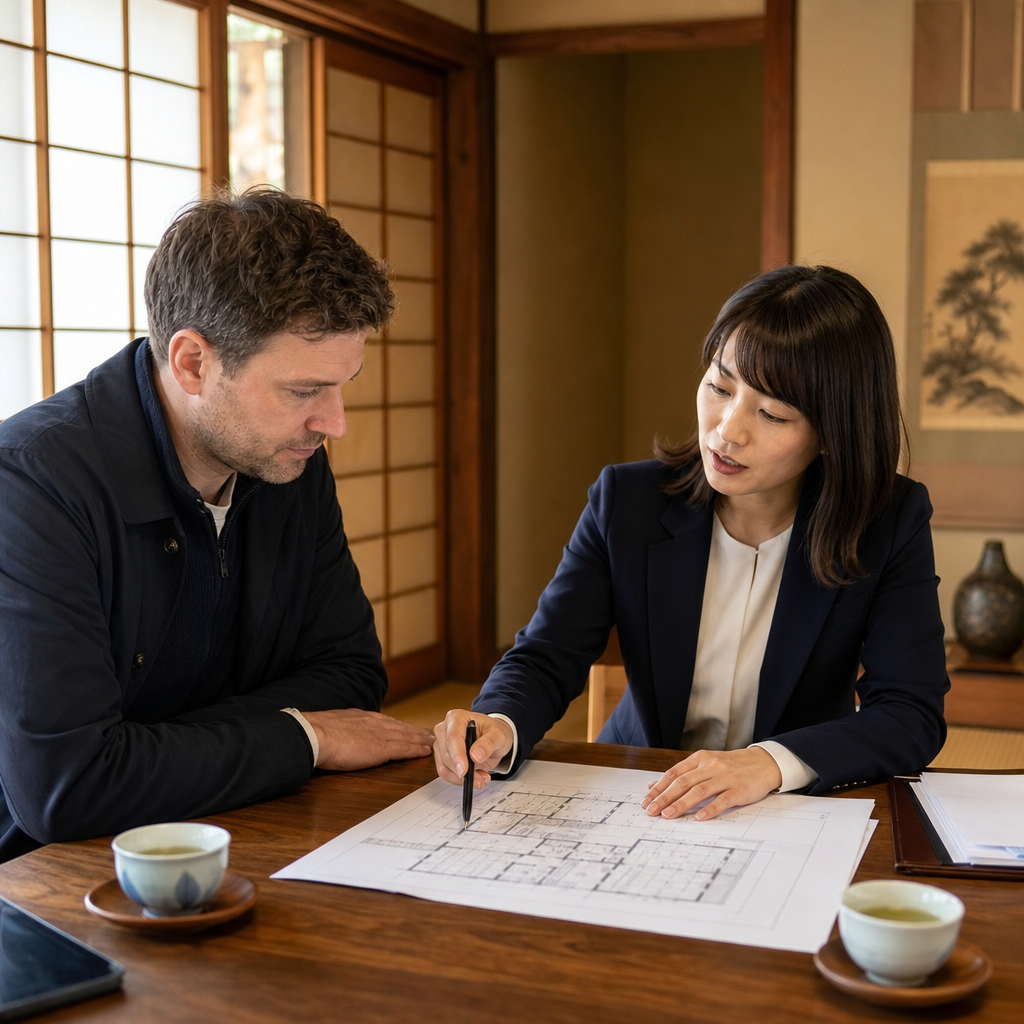
Read this in English before signing anything. The contingencies clause is where foreign buyers most often wish they’d paid more attention.
The Purchase Agreement (売買契約書)
Once the offer is accepted, you sign the actual contract. At this stage:
- You’ll pay the deposit (手付金), typically 5–10% of the purchase price
- The agreement will specify the closing date, final price (including taxes and fees), and any items included in the sale (fixtures, appliances)
- The agreement is in Japanese — your agent must explain it to you before you sign
The Closing Documents
Actual closing in Japan is less dramatic than Western closings. There’s no closing ceremony. You sign documents, transfer funds, and the registration happens at the legal affairs bureau — which takes 1–2 weeks to process after submission.
What you receive:
- A copy of the registered transfer (登記識別情報)
- The final settlement statement (精算書) showing all fees and the final amount
- Keys, naturally
What We Did Differently
We used an English-speaking agent for our purchase, which cost slightly more but saved enormous stress. We also had an administrative scrivener present at every signing — not just the final one.
The one thing we’d change: we would have prepared more Japanese translation of our personal documents (proof of income, bank statements, ID) before arriving. Getting documents officially translated takes time and money. Preparing bilingual versions of standard documents before you start speeds everything up.
The Honest Reality Check
Can you buy an akiya without speaking Japanese? Yes. Can you buy one entirely remotely, never visiting until the final closing? Partially — with significant cost and complexity. Can you navigate the process with basic Japanese and good professional support? Absolutely — and this is the most common path for foreign buyers.
The language barrier doesn’t stop the purchase. It just means you need the right people around you, more lead time, and a willingness to pause and ask for explanations before signing anything.
Start building your team before you find a property. The property you want may only be on the market for a few weeks.
Building your team and want a head start? Book the Akiya Tour in Setagaya on Airbnb → — we bought and renovated this house as foreigners, and the tour is the easiest place to ask how we handled the language barrier at every step.
Get the akiya cost breakdown we won't publish publicly
Join for renovation numbers, contractor lessons, sourcing notes, and behind-the-scenes updates from our Tokyo akiya.
Want the real akiya numbers, not just the pretty photos?
Subscribe for renovation cost breakdowns, contractor lessons, antique finds, and the next story before casual visitors see it.
No spam. Just the strongest restoration stories, real costs, and occasional tour news.