How Much Does an Akiya Really Cost? A Realistic Price Guide
By Minseon
The articles are irresistible: “House in Japan for ¥1.” “Abandoned property — take it away.” “The towns paying people to move there.”
You scroll through photos of moss-covered roofs, tatami rooms with afternoon light, mountain villages where the only sound is wind. The price tags are almost unbelievable.
And then you start asking questions — and the real numbers emerge.
Why Akiya Prices Range From ¥0 to ¥50 Million
The word akiya (空き家) just means “vacant house.” It says nothing about the condition, location, or history of the property. A crumbling shed in a mountain village in Tohoku and a solid 1980s wooden house in Setagaya are both technically akiya.
That range is why price discussions are so confusing.
Here’s a rough framework:
Rural and depopulating areas (mountain villages, small towns losing population) These are where the ¥1 and free house stories come from. Municipalities actively want to offload abandoned properties because they still cost the community in property management, fire risk, and visual blight. Purchase prices in these areas range from essentially zero to a few hundred thousand yen — sometimes with conditions attached, like completing renovation within a set timeframe.
Medium-sized cities and regional hubs Cities like Niigata, Nagano, or smaller prefectural capitals with stable but slow local economies have a mix. Prices typically range from a few hundred thousand yen to low millions for reasonable properties, with occasional auctions at very low starting bids.
Urban areas (Tokyo, Osaka, Kyoto, major cities) This is where the picture changes completely. Urban akiya — particularly in desirable wards like Setagaya, Nakano, or Suginami in Tokyo — are not free. They’re often 20–50% cheaper than equivalent live-in properties, but they’re still real estate in one of the world’s most expensive real estate markets. A wooden house on its own land in Setagaya costs real money — because the land it’s on is worth a great deal.
The Auction Reality
Akiya auctions (競売, keibai) are where the dramatic discount stories come from. Properties at judicial auction can sell at 30–70% below estimated market value.
But auctions are not a shopping experience.
What auctions don’t tell you:
- The property may have unpaid property taxes, utilities, or other debts secured against it
- Access may not have been verified — you may not be able to enter before purchasing
- Condition disclosures are minimal to none
- Most auctions require full payment within 30 days — no mortgages, no extensions
- If the previous owner is still occupying, eviction is a separate legal process
What auctions do well:
Get the akiya cost breakdown we won't publish publicly
Join for renovation numbers, contractor lessons, sourcing notes, and behind-the-scenes updates from our Tokyo akiya.
- Create genuine price competition based on value, not emotion
- Work well for experienced buyers with cash and legal support
- Are increasingly used by professional renovators who know how to assess a property quickly
The Cost That Swallows the Purchase Price
Here’s the thing nobody talks about enough: for urban akiya, the purchase price is usually the smallest number on the spreadsheet.
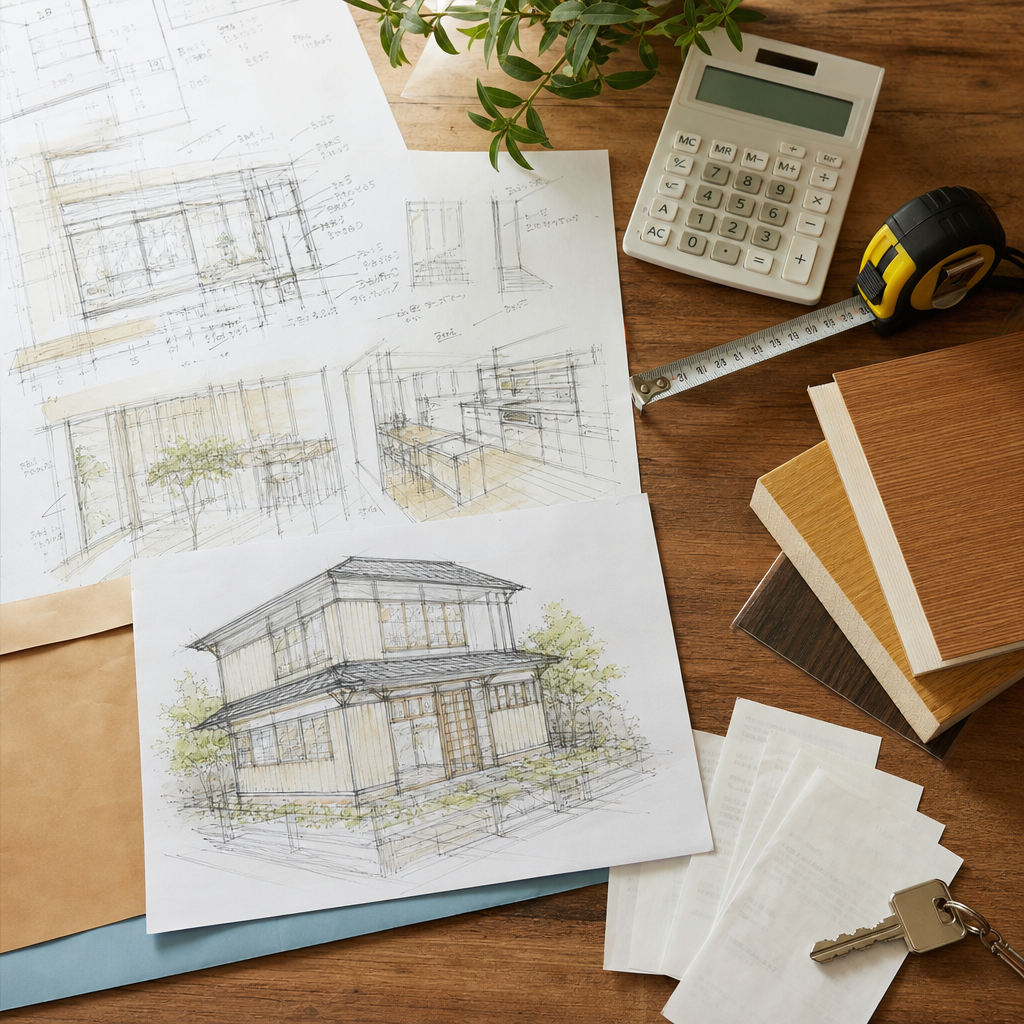
Renovation costs for a deteriorated urban property — seismic reinforcement, foundation repair, re-insulation, systems updates, finishes — typically run anywhere from a modest amount to multiples of the purchase price, depending on scope.
A rural free house sounds appealing until you understand that bringing it up to a livable standard — or even just a safe, weatherproof state — may cost more than building new.
This is why experienced akiya buyers talk about “total investment cost” rather than purchase price. The question isn’t “how much is the house?” It’s “how much will it cost me to have the house I want?”
What Drives the Price Up or Down
Drives price down:
- Significant structural deterioration
- Hazardous material (asbestos, old chemical insulation)
- Difficult or unclear land ownership history
- Location in a depopulating area with no local demand
- Previous owner still occupying or with unresolved estate issues
Drives price up:
- Solid structural condition (or minimal work needed)
- Clear land ownership (no shared ownership complications)
- Convenient location with good transit access
- Traditional features worth preserving (original timber, period details)
- Already registered or eligible for various renovation subsidies
What We Paid — And What It cost
Our Setagaya property was not free. In the context of Tokyo real estate, it was priced at a meaningful discount to comparable live-in properties — reflecting the condition, the vacancy, and the renovation scope required.
Was it worth it? The total investment — purchase plus renovation — was less than half of what a new apartment of equivalent size would cost in the same ward. We have a house with character, history, and a level of space and privacy that new construction in Tokyo simply doesn’t offer at any price.
The calculus is different for everyone. But the first step is understanding what the numbers actually are. If you want to see the line items rather than the ranges, I’ve published the full cost breakdown spreadsheet from our renovation — every category, every yen, original quote versus what we negotiated down to.
Ready to explore what an akiya actually costs in your target area? Book a tour and see a real restored urban property before you start your search.
Related reading: How to find an akiya in Japan · The hidden costs of akiya renovation · Can foreigners get a mortgage for an akiya?
Get the akiya cost breakdown we won't publish publicly
Join for renovation numbers, contractor lessons, sourcing notes, and behind-the-scenes updates from our Tokyo akiya.
Want the real akiya numbers, not just the pretty photos?
Subscribe for renovation cost breakdowns, contractor lessons, antique finds, and the next story before casual visitors see it.
No spam. Just the strongest restoration stories, real costs, and occasional tour news.