How to Find Reliable Contractors for Akiya Renovation in Japan — A Practical Guide
By Minseon
Why Finding Good Contractors Is Specifically Hard for Akiya
Renovation contractors in Japan are not in short supply. The problem is a different one: most of them don’t want to work on akiya.
An akiya renovation is complicated. The houses are old, often in poor condition, frequently have structural issues that only become apparent after demolition starts, and almost always involve working around traditional building techniques that most modern contractors have never learned. Add to that the fact that most foreign buyers need contractors who can communicate in English or through a bilingual intermediary, and you’ve narrowed your pool significantly.
The good news: they exist. The bad news: they are busy, selective about projects, and often not listed anywhere you can find them with a Google search.
Start With Your Existing Network
Before searching anywhere, ask the people who already know your property:
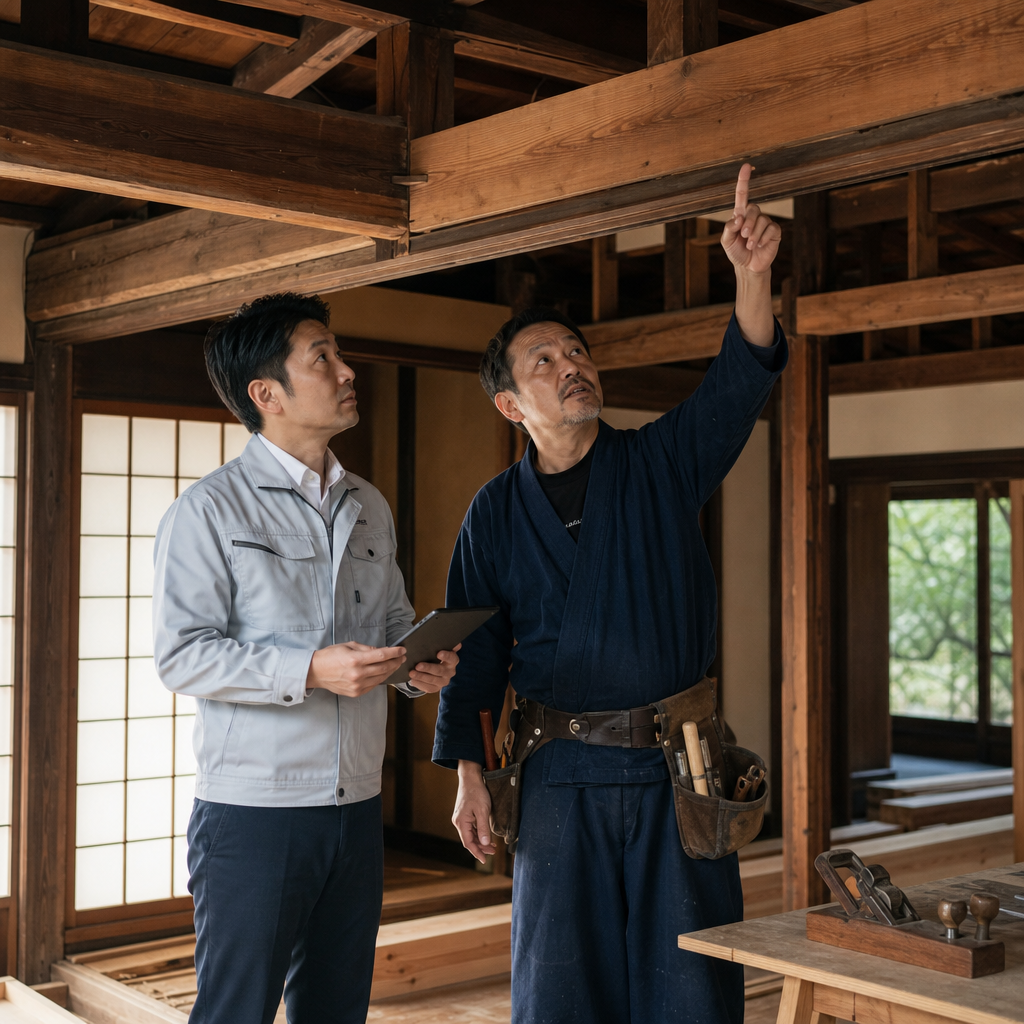
Your buyer’s agent. They have done this before with other clients. They know which contractors returned calls, showed up on time, and finished projects without catastrophic surprises. This is the single highest-quality lead you have.
Your lawyer or notary. They work with real estate transactions and often have contacts in the renovation industry. They also have an incentive to refer reliably — their reputation is attached to the transaction.
The previous owner or the local ward office. In some cases, the previous owner will share the contact information of contractors who have worked on the property before. Ward offices in Tokyo maintain lists of licensed contractors and can sometimes make introductions.
Where to Search
Tokyo-Specific Resources
Tokyo Constructor Association (東京建設協会) — maintains a directory of licensed contractors searchable by ward and specialty. The website is in Japanese, but browser translation handles it.
Homepro (ホームプロ) — a contractor matching platform with reviews. Contractors on Homepro have been vetted and carry insurance. Particularly strong for mid-size renovation projects.
Reco (レコ) — similar to Homepro, focused on renovation matching. Has a higher proportion of newer contractors but also good coverage in the Tokyo area.
Kakukakari (かくかくり) — a newer platform connecting homeowners with renovation contractors. Less comprehensive than Homepro but sometimes has contractors not listed elsewhere.
Word of Mouth (Highest Quality)
Expat Facebook groups — r/japanlife, Tokyo Home Renovation, Japan Property. Search for contractor recommendations and pay attention to posts where people mention specific companies they’ve actually used. Personal referrals from people who did similar projects are worth more than any directory.
Hyper-local exploration. Walk around your neighbourhood in Setagaya or Suginami and look for houses being renovated. Note the company names on the signs (現場氏名看板). Many contractors are small operations that never advertise — they get work through exactly this kind of local visibility.
What to Look For
A reliable contractor for an akiya renovation will have some non-negotiable qualities:
Experience with older wooden structures. This is different from new construction or modern apartment renovation. Ask specifically: how many pre-1980 wooden houses have you renovated? The answer tells you everything.
Willingness to do a thorough pre-project inspection. Good contractors will spend time at the property before giving you a quote. They should be looking for rot in the structure, condition of the foundation, the state of the plumbing, and any obvious hazard materials.
Get the akiya cost breakdown we won't publish publicly
Join for renovation numbers, contractor lessons, sourcing notes, and behind-the-scenes updates from our Tokyo akiya.
Transparent pricing with a written scope of work. Vague quotes are a red flag. A proper quote includes a sōshiki (仕様書, specification document) that details exactly what materials and methods will be used.
References from similar projects. Ask for contact details of previous clients who did a comparable scope of work. A contractor who has done three akiya renovations in the last two years is more valuable than one who has done twenty apartment renovations.
Availability within your timeline. Many good Tokyo contractors are booked 3–6 months out. If your timeline is urgent, factor that into your search starting point.
Questions to Ask Before Hiring
Ask every contractor these before signing anything:
- Have you worked on pre-1980 wooden houses in this ward before?
- Who will be the site supervisor, and how often will they be on-site?
- What is your process for discovering hidden damage after demolition begins?
- Who coordinates the structural engineer and specialist craftspeople?
- What is your payment schedule? (Red flag: large upfront payments)
- Can I speak with two clients who had similar projects?
- What is your approach to unexpected cost increases?
- Do you have builder’s insurance (建築工事保険)?
Red Flags
Quote arrived within 24 hours. A proper quote for a complex renovation takes time. Fast quotes usually mean the contractor hasn’t actually read the property condition carefully.
Won’t let you visit a current site. Ask to see a site in progress. A contractor who refuses is hiding something.
Only communicates by email, never on the phone or in person. Renovation communication requires real-time problem-solving. Email-only contractors create delays and misunderstandings.
Pressure to sign quickly. Good contractors don’t need hard-sell tactics. If someone is pushing you to sign a contract within 48 hours, walk away.
Quote is significantly lower than all others. In renovation, the lowest quote is almost never the best value. It usually means corners will be cut.
The Architect Option
For any renovation involving structural work, seismic compliance, or significant changes to the layout, hiring a registered architect (一級建築士 or 二級建築士) as a project manager is strongly recommended.
The architect:
- Produces detailed construction drawings (施工図)
- Acts as your representative on-site
- Reviews contractor quotes against a written scope
- Can flag problems before they become expensive
- Coordinates the various specialist contractors
Architect fees in Tokyo are typically 5–10% of the total construction cost. On a ¥15M renovation, that’s ¥750K–¥1.5M. We spent this and it was the best money we spent on the entire project.
Look for architects who specifically advertise 木造住宅 (wooden house) or 中古住宅改装 (used house renovation) experience. General commercial architects often don’t have the right background for traditional Japanese wooden structures.
What We Did
We hired a bilingual architect in Setagaya before we hired a single contractor. She produced the full renovation drawings, obtained the building permits, and managed the contractor relationship on our behalf.
The general contractor we chose came through her network — a small family operation in Setagaya that had been doing renovations in the area for three generations. They were not the cheapest quote. They were the most thorough: they spent two hours at the property before giving us a quote, pointed out three structural issues that the other bidders had missed, and had references from two previous akiya projects.
The total project cost was higher than the optimistic estimate. The rework cost was zero.
The negotiation that got us from the contractor’s first quote (¥23.1M) down to the signed contract (¥15M) is documented as 9 specific plays in our negotiation playbook — including how we handled “list price -55%” theatre, owner-supplied materials, and the 「別途」 (extras) clause that catches most foreign buyers off-guard.
Timeline and Budget Reference
| Phase | Typical duration | Typical cost range |
|---|---|---|
| Finding and vetting contractors | 4–8 weeks | Free |
| Architect engagement | 2–4 weeks | ¥500K–¥2M |
| Permit applications | 4–12 weeks | ¥100K–¥300K |
| Structural assessment | 2–4 weeks | ¥100K–¥300K |
| Construction (full renovation) | 6–12 months | ¥8M–¥25M |
| Total typical project | 10–18 months | ¥10M–¥30M |
If you want to talk through contractor strategy before you buy, book a tour of our Setagaya property and ask us directly. We’ve done this search twice and learned what questions actually matter.
Related reading: How much does akiya renovation cost in Japan? · Can foreigners get a mortgage for akiya in Japan? · The akiya closing process in Japan
Get the akiya cost breakdown we won't publish publicly
Join for renovation numbers, contractor lessons, sourcing notes, and behind-the-scenes updates from our Tokyo akiya.
Want the real akiya numbers, not just the pretty photos?
Subscribe for renovation cost breakdowns, contractor lessons, antique finds, and the next story before casual visitors see it.
No spam. Just the strongest restoration stories, real costs, and occasional tour news.