Why Are There So Many Abandoned Houses in Japan?
By Minseon
If you’ve ever wandered through a quiet Japanese neighborhood and noticed a house that looked like time had stopped inside it — curtains still hanging, a rusted bicycle leaning against the gate, a garden that used to be tended — you’ve seen the akiya problem up close. Japan has more than 9 million abandoned houses. That number is almost impossible to hold in your mind. But each one of those houses has a story, and most of those stories share a common thread.
I think about this a lot. Our house was one of those statistics — sitting empty for years before we came along. Understanding why it was abandoned helped me understand something much larger about Japan.
A Country Running in Reverse
The most fundamental reason there are so many abandoned houses in Japan is demographic: Japan’s population is shrinking. The country has one of the lowest birth rates in the world and very little immigration. Meanwhile, young people are drawn to cities — Tokyo, Osaka, Nagoya — where the jobs and energy are. Rural towns and suburban neighborhoods built for a different era are left behind.
Houses outlive their owners. When an elderly resident passes away, there’s often no one nearby who wants to take on the property. Children moved to the city decades ago. Grandchildren grew up there. The house just sits.
This isn’t a short-term trend. It’s structural. And it means the number of empty homes in Japan is expected to keep rising.
The Inheritance Trap
Here’s something that surprises many people: in Japan, inheriting a property doesn’t feel like receiving a gift. It feels like receiving a bill.
When you inherit a house, you inherit the tax obligations and the maintenance responsibility that come with it. For an heir living in Tokyo — or abroad — a crumbling farmhouse three hours away isn’t an asset. It’s a problem. And problems with no easy solution tend to get ignored.
The legal and administrative process of transferring ownership is also complex and expensive. Many families find themselves in a kind of paralysis: they don’t want the property, but formally rejecting or transferring it requires effort they haven’t gotten around to making. And so the house sits, for years, sometimes for decades.
The Structure Is Worth Nothing
There’s a cultural dimension to this that’s easy to miss if you’re coming from a Western context. In Japan, old houses are not generally considered valuable. The land has value — the structure on top of it is treated as a liability.
Get the akiya cost breakdown we won't publish publicly
Join for renovation numbers, contractor lessons, sourcing notes, and behind-the-scenes updates from our Tokyo akiya.
A house in Japan depreciates rapidly. After 20 or 30 years, a wooden structure is typically assessed at near-zero value on paper, regardless of its actual condition. This mindset shapes everything: sellers can’t get what they think a house is worth, buyers are wary of taking on something “old,” and the whole transaction stalls.
This is very different from how people in, say, Europe or America might think about a century-old building. In many Western markets, age adds character and value. In Japan, it has historically subtracted it.
The Perverse Logic of Demolition
You might wonder: if the house is worth nothing, why not just tear it down?
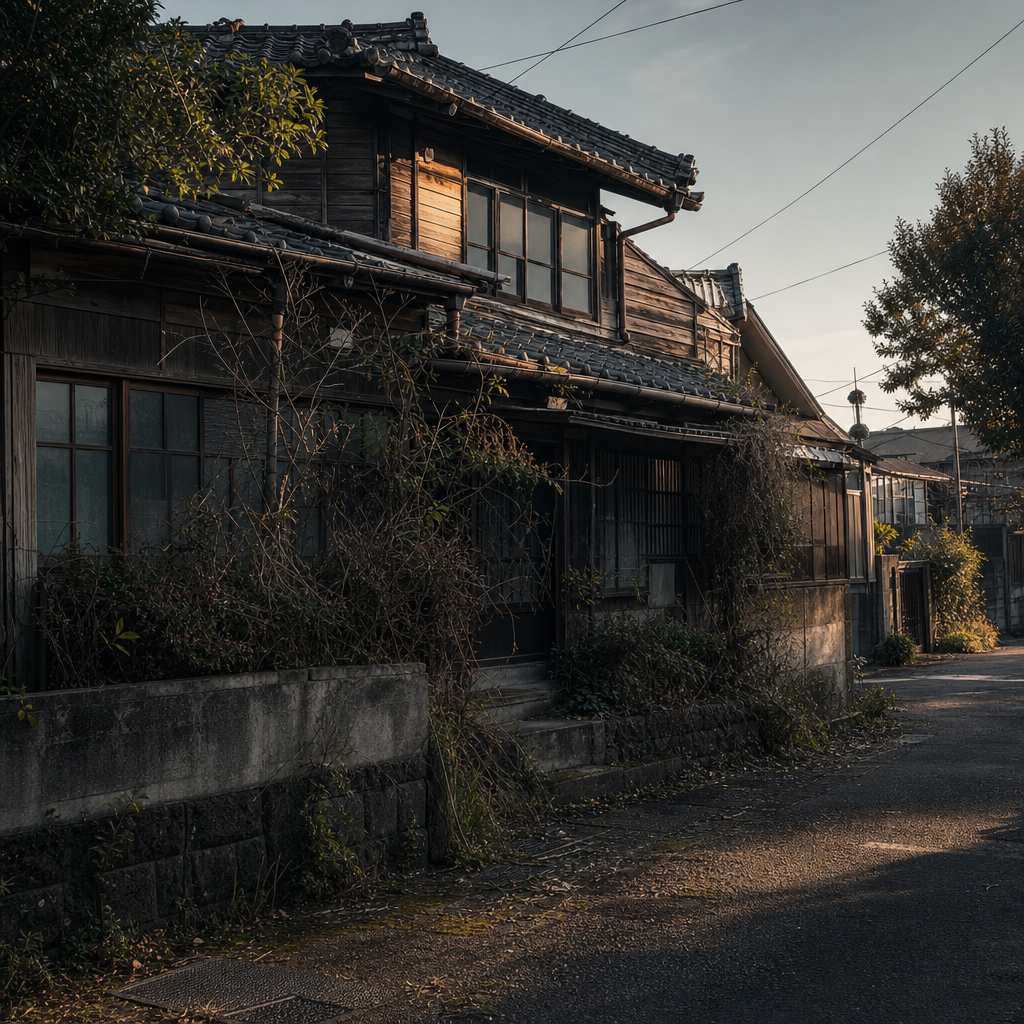
The answer reveals one of the stranger quirks of Japanese tax law. Demolishing a house and leaving a vacant lot actually increases your tax burden, because residential structures qualify for a significant reduction in land tax. Remove the structure, and that reduction disappears. A crumbling house, legally speaking, costs less to own than an empty lot.
Add to that the fact that demolition itself is expensive, and you can see why families make the rational — if strange-looking — choice to leave a deteriorating structure standing rather than clear the land. The incentive structure practically ensures abandonment.
Something Is Shifting
This is not a story without hope. Municipalities across Japan have become increasingly proactive about the akiya problem. Some are listing properties for sale for nominal amounts. Others are offering grants or subsidies for restoration. The national government has amended inheritance laws to make property transfer less of a bureaucratic maze.
And culturally, something is changing too. Younger Japanese people — and a growing number of foreign residents and buyers — are starting to see these houses differently. Not as liabilities, but as opportunities. As places with history worth preserving. As homes that can be brought back.
The akiya movement is real. It’s small, but it’s growing.
Why I Think About This
Our house was one of those 9 million — empty for years, its story paused. Restoring it felt like making an argument: that things of a certain age don’t have to be discarded. That a house can hold more value than its assessed price suggests.
I didn’t set out to make a political statement. I just wanted to bring a house back to life. But the akiya process taught me that every restored home is a small refutation of the logic that created the problem.
The akiya problem is real — but it’s also an opportunity. Empty houses are waiting across Japan, each one a chance to ask what we actually value.
The best way to understand what that means isn’t to read about it. It’s to stand inside a restored house and feel what was almost lost.
Join me for the akiya tour in Tokyo →
Related reading: How to find an akiya in Japan · What is a kominka? · What is akiya restoration?
Get the akiya cost breakdown we won't publish publicly
Join for renovation numbers, contractor lessons, sourcing notes, and behind-the-scenes updates from our Tokyo akiya.
Want the real akiya numbers, not just the pretty photos?
Subscribe for renovation cost breakdowns, contractor lessons, antique finds, and the next story before casual visitors see it.
No spam. Just the strongest restoration stories, real costs, and occasional tour news.