Is It Safe to Live in an Old Japanese House? What You Need to Know About Earthquakes and Akiya
By Minseon
When people find out I live in a 70-year-old wooden house in Tokyo, the first question is almost always the same: “But isn’t that dangerous? What about earthquakes?”
It’s a completely fair question — and if you’re researching old Japanese house earthquake safety before committing to an akiya, you’re asking exactly the right thing. Japan is one of the most seismically active countries on Earth, and old wooden houses have a real history of performing poorly in major earthquakes. I’m not going to dismiss the concern — I spent a long time thinking about it myself. But I also want to give you the honest, specific answer, because “old house = dangerous” is too simple, and so is “it’s fine, don’t worry.”
The Building Code Divide: 1981 and 2000
Japanese seismic construction standards (taishin kijun) have been revised several times, but two years matter most.
1981 was the major turning point. That year, Japan introduced the shin taishin kijun — the “new seismic standard.” Houses built to this standard are designed to withstand strong shaking without collapsing, even if they sustain damage. Houses built before 1981 were designed to an older, weaker standard. Research after the 1995 Kobe earthquake confirmed this clearly: the majority of deaths from structural collapse occurred in pre-1981 buildings.
2000 brought a further update specifically for wooden structures (mokuzō jutaku). It introduced stricter requirements for wall bracing, connector hardware at joints, and foundation design. A house retrofitted to meet the 2000 standard has been brought up to the current benchmark for wooden residential construction.
If you’re looking at an akiya, the first thing you want to know is: when was it built, and has it been assessed or retrofitted?
What “Unsafe” Actually Means
Most earthquake deaths in Japan are caused by structural collapse — not fire, not tsunami (in inland areas), not objects falling, but the building itself coming down. Pre-1981 wooden houses without any seismic work are statistically at significantly higher risk of this kind of collapse in a major earthquake.
That’s the real danger. And it’s important to name it clearly, because it also points to the solution.
A house that has been properly assessed and retrofitted — with bracing added to weak walls, joints reinforced with metal connectors, and foundations checked or repaired — can perform comparably to new construction in the same earthquake. The structure’s age matters less than its current condition and whether it meets modern standards.
Get the akiya cost breakdown we won't publish publicly
Join for renovation numbers, contractor lessons, sourcing notes, and behind-the-scenes updates from our Tokyo akiya.
This is a solvable problem. But it has to be done properly, with a licensed structural assessment before and after the work.
What the Retrofit Process Looks Like
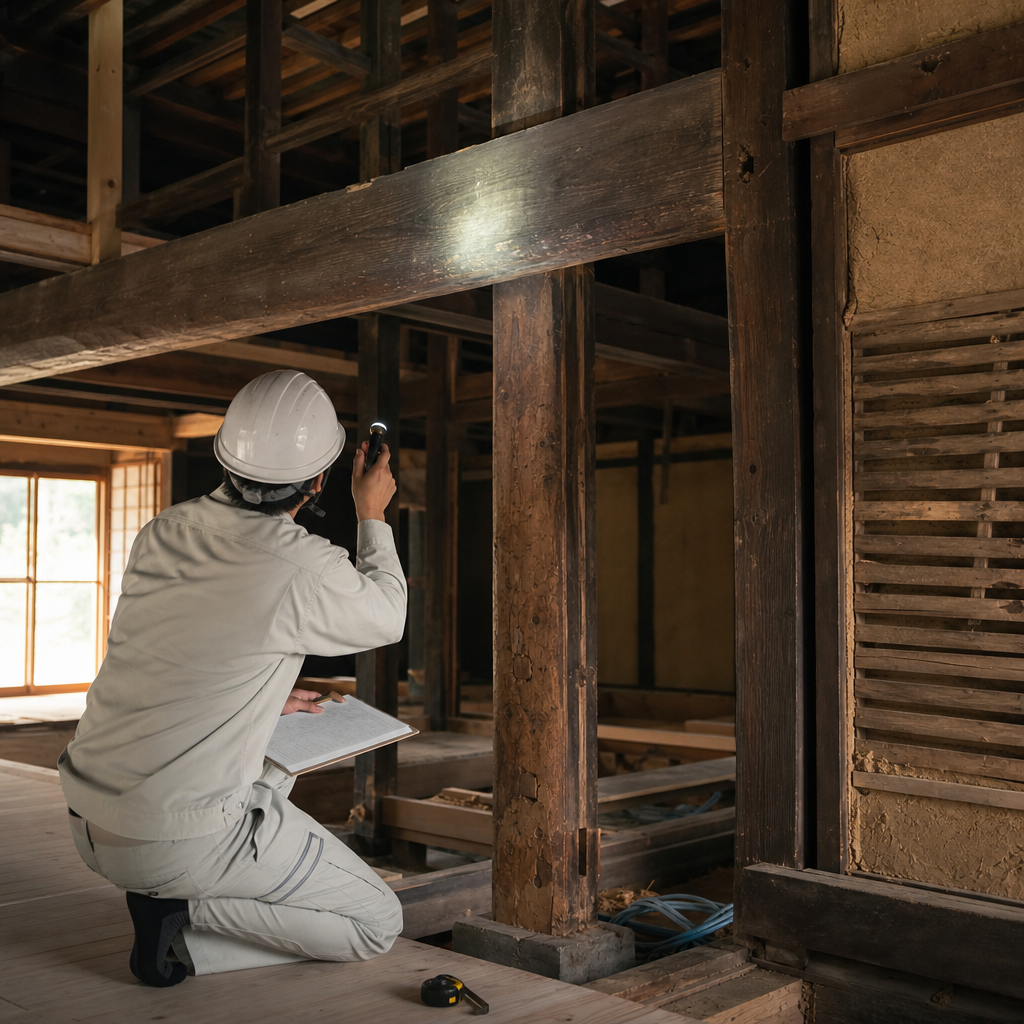
When I decided to restore my akiya, I knew the seismic question wasn’t something I could skip. Here’s what the process actually involved:
-
Structural assessment (taishin shindan): A licensed inspector evaluates the existing structure — wall bracing ratios, joint conditions, foundation integrity — and produces a score that tells you how far the house is from current standards.
-
Seismic reinforcement work: Based on the assessment, a structural engineer and contractor design the reinforcements. In my case, this included adding X-bracing to key walls (you can actually see it in the living room), installing metal connector hardware at critical joints, and repairing sections of the foundation.
-
Post-retrofit re-assessment: Once the work is complete, the house is re-evaluated to confirm it meets the target standard.
My house passed its post-retrofit assessment and meets the 2000 shin taishin kijun. That’s the honest answer to “is it earthquake safe.” Not “perfectly safe” — no building anywhere in the world is fully earthquake-proof — but structurally reinforced, assessed, and meeting current Japanese code.
If you want to go deeper on what the retrofit work actually involved, I wrote about it in detail here: How I Seismically Retrofitted My Akiya.
The Honest Caveat
Japan’s major earthquakes — Kobe in 1995, the Tōhoku disaster in 2011 — caused damage to structures of all kinds, including some newer ones. I won’t pretend otherwise. Seismic engineering reduces risk; it doesn’t eliminate it. Living in Japan means accepting that earthquakes are a fact of life, and making thoughtful choices to reduce your exposure.
What I can say is that an unrenovated pre-1981 akiya carries real, documented structural risk. A properly retrofitted one does not carry that same risk. The gap between those two situations is large, and the retrofit is what closes it.
The Broader Takeaway for Akiya Buyers
If you’re considering an akiya — as a home, a renovation project, or an investment — seismic safety should be near the top of your due diligence list. Ask when the house was built. Ask whether it’s been structurally assessed. If it hasn’t, get an assessment before committing.
Old houses in Japan are not automatically dangerous. But they are also not automatically safe. The difference is in the work that has or hasn’t been done.
If you want to see what seismic retrofitting actually looks like in a real house — the X-bracing, the connector hardware, the foundation work — come on the tour. I’ll show you everything, walk you through the decisions I made, and answer whatever questions you have.
👉 Book the Akiya Tour on Airbnb Experiences
Related reading: The hidden costs of restoring an akiya · What is akiya restoration? · How to find an akiya in Japan
Get the akiya cost breakdown we won't publish publicly
Join for renovation numbers, contractor lessons, sourcing notes, and behind-the-scenes updates from our Tokyo akiya.
Want the real akiya numbers, not just the pretty photos?
Subscribe for renovation cost breakdowns, contractor lessons, antique finds, and the next story before casual visitors see it.
No spam. Just the strongest restoration stories, real costs, and occasional tour news.