We Spent Weeks on Seismic Retrofitting a Tokyo Akiya. Here's the Honest Breakdown.
By Minseon
If you’re thinking about restoring an old Japanese house — an akiya — the first question isn’t about aesthetics. It’s about whether the building can survive an earthquake.
Japan updated its seismic building codes in 1981 (新耐震基準, shin taishin kijun) and again in 2000. Any wooden house built before 1981, and many built after, will likely need 耐震工事 (taishin kōji — seismic reinforcement work) before you can renovate safely or legally. Our akiya in Setagaya had been sitting empty for years and had never been updated to modern standards.
Here’s what the seismic retrofit actually involved.
Why You Can’t Skip This Step
I want to be honest: when we first walked through the house, I wanted to talk about walls and floors and plaster. My contractor shut that conversation down immediately.
In our case, the sequence wasn’t the textbook one. We demolished the interior first — and only then did we have a full structural assessment. An engineer came in after the walls were already open to inspect the frame, the foundation, and the wall-bracing ratios. The assessment takes half a day and costs somewhere in the tens of thousands of yen — a small price for what it tells you. What came back was a detailed report explaining which parts of the structure met current standards — and which didn’t.
The short version: the foundation had problems, the bracing needed upgrading, and the insulation was essentially nonexistent by modern standards. The bracing was actually a surprise. Our architect had planned on the assumption there were none at all. With the interior demolished and the frame exposed, the inspection revealed seismic braces already in place — just not up to current standards. Someone had thought about this before us. Seeing it all laid out in the report still made the work feel real.
(Most guides recommend doing the structural assessment before demolition. We didn’t — and it worked out, but knowing what we know now, earlier is better.)
Stripping Down to the Frame
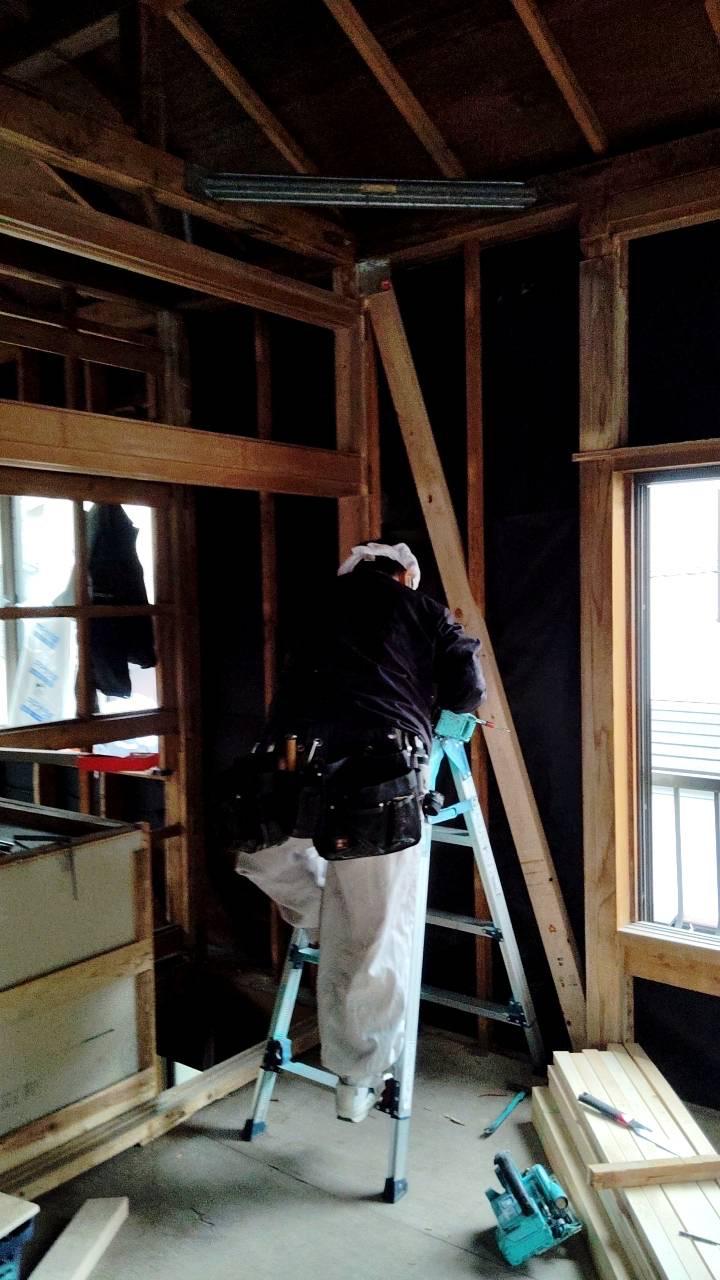
Seismic work can’t happen on top of finished walls. We stripped back to the structural frame in several rooms — exposing the posts (柱, hashira), beams (梁, hari), and the existing diagonal bracing.
The wood was old but solid. You could tell this house was built carefully. But budget time and space for this phase — it generates a huge amount of waste and the house is genuinely uninhabitable during it.
Get the akiya cost breakdown we won't publish publicly
Join for renovation numbers, contractor lessons, sourcing notes, and behind-the-scenes updates from our Tokyo akiya.
The Actual Reinforcement
Our retrofit had three main components:
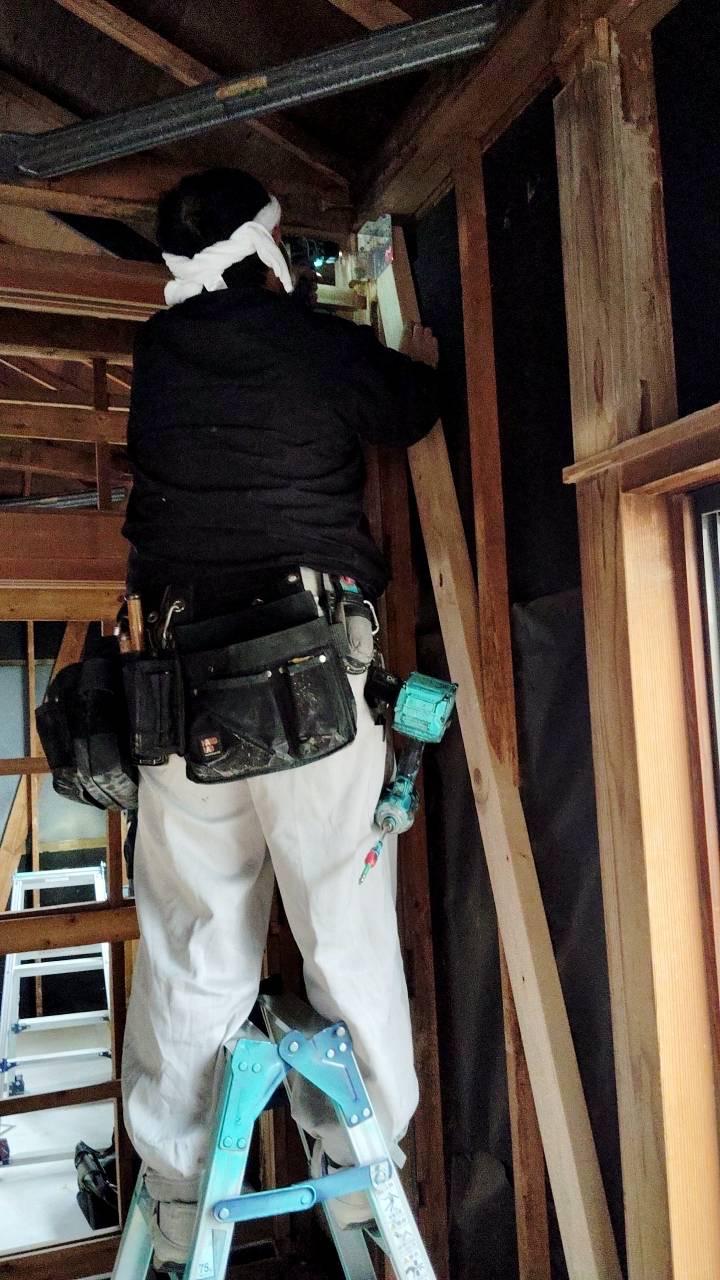
1. Steel X-bracing and metal connectors Steel plates and metal joint connectors were added at critical connection points throughout the frame — where posts meet beams, where the wall meets the floor, and at corners. These prevent the kind of racking movement that causes wooden houses to collapse laterally in an earthquake.
2. Structural plywood shear walls Structural-grade plywood panels were added to specific walls to increase shear resistance — essentially a rigid skin inside the wall before re-cladding. This significantly improves the wall’s ability to resist lateral forces.
3. Foundation repair This was the part that stung the most. Several of the original wooden foundation posts — dodai (土台) — had absorbed moisture over the decades and were showing significant rot. We replaced the compromised sections with treated lumber and added proper moisture barriers. The rotted foundation timber we pulled out looked alarming; it had been quietly failing for years.
A Few Things I Wish I’d Known
Get the subsidy first. Tokyo offers partially subsidized 耐震診断 (taishin shindan) assessments through the ward office. Setagaya City covers part of the inspection cost. I didn’t know this and paid full price. Check with your 区役所 (kuyakusho) before hiring anyone.
Budget a contingency. Open walls reveal things: old wiring, mold, pipes that needed replacing years ago. The seismic phase alone can run into the millions of yen for a full-sized house — and that’s before the walls go back on. Whatever quote you get, assume there’s more hiding behind the walls.
Exposed bracing can be beautiful. We left some of our X-bracing visible in the living room. The steel-and-wood cross pattern is now one of the most distinctive features of the house — honest architecture that shows exactly how it holds itself up.
Is It Worth It?
After the seismic work was complete, our engineer re-assessed the structure. We went from a score that wouldn’t meet current standards to one that does. The house is now as safe as a new-build in a seismic event — and it still has all the character and warmth that a new-build will never have.
That’s the bargain you make with an akiya. You invest in the bones so the soul can survive.
If you want to see the finished result — exposed beams, X-bracing in the living room, and all — book a tour on Airbnb. Tours run April 2026 in English, Italian, Japanese, and Korean.
Related reading: The hidden costs of restoring an akiya · What is akiya restoration? · Is it safe to live in an old Japanese house?
Get the akiya cost breakdown we won't publish publicly
Join for renovation numbers, contractor lessons, sourcing notes, and behind-the-scenes updates from our Tokyo akiya.
Want the real akiya numbers, not just the pretty photos?
Subscribe for renovation cost breakdowns, contractor lessons, antique finds, and the next story before casual visitors see it.
No spam. Just the strongest restoration stories, real costs, and occasional tour news.