Using Traditional Shikkui Plaster in Our Tokyo Akiya: The Unexpected Benefits We Found
By Minseon
When people ask me what made the biggest difference in restoring my akiya, my answer surprises them: the walls. Specifically, the decision to use shikkui plaster Japan’s traditional builders relied on for centuries — rather than the modern drywall and vinyl sheets that became standard after the postwar housing boom. If you’ve ever stepped into an old Japanese farmhouse or a castle turret and noticed a certain stillness, a softness to the air, there’s a good chance shikkui had something to do with it.
What Shikkui Actually Is
Shikkui (漆喰) is a traditional Japanese lime plaster made from a few humble ingredients: slaked lime (消石灰, shōsekkai), hemp or straw fibers, sometimes dried seaweed paste (funori), and water. That’s essentially it. The fibers bind the mixture and prevent cracking as it cures; the seaweed acts as a natural adhesive. The result is a plaster that hardens slowly, bonding deeply to whatever substrate it’s applied to.
What makes it remarkable isn’t the ingredient list — it’s what those ingredients do together. Shikkui is alkaline, which makes it naturally antimicrobial and resistant to mold. It’s porous in a controlled way, so it absorbs humidity when the air is damp and releases it when the air dries out, gently regulating the environment of a room. And it’s fireproof: many of the historic kura (storehouses) that survived fires in old Japanese towns survived precisely because of their thick shikkui walls.
A Material Built Over Centuries
Traditional Japanese lime plaster has been used in castle walls, temple interiors, and merchant townhouses for well over four hundred years. You can see it in the white-plastered walls of Himeji Castle, in the machiya townhouses of Kyoto, in the earthen and plaster kura that still dot the Japanese countryside. It was the standard interior and exterior wall finish for any building worth the trouble — and builders chose it not just for aesthetics, but because it worked.
The postwar decades changed that. Japan needed housing fast, and shikkui is slow: it requires skilled hands, multiple coats, and time. Cheaper materials took over. Many of the akiya that sit empty across Japan today were built in that era — with walls that cost less but breathe less, that feel hollow when you knock on them, that don’t age gracefully.
Get the akiya cost breakdown we won't publish publicly
Join for renovation numbers, contractor lessons, sourcing notes, and behind-the-scenes updates from our Tokyo akiya.
Shikkui restoration means bringing some of that older intelligence back.
How It’s Applied
Watching a skilled plasterer work with shikkui is a little like watching someone ice a very large, very important cake — except the stakes are higher and the technique has been refined over generations. The plaster is applied in layers using a steel trowel (kote), starting with a base coat to fill and level the surface, then a middle coat to build thickness, and finally a finish coat that determines the texture and appearance.
That finish coat is where the real decisions happen. A smooth, burnished surface — achieved by working the wet plaster with the flat of the trowel — gives shikkui its characteristic luminous quality, almost like a matte stone. A more textured finish, worked with a sponge or a rougher tool, produces something warmer and less formal. Both are beautiful in different ways.
The drying process is part of the craft too. Shikkui doesn’t just dry — it carbonates, slowly absorbing CO₂ from the air and converting back into limestone. A properly cured shikkui wall will continue hardening for months, becoming more durable over time rather than less.
What It Feels Like to Live With
There’s a quality to a shikkui wall that doesn’t translate well in photographs. The surface has a subtle depth — it isn’t perfectly flat, even when it looks flat — and in certain light it seems to glow faintly. The room feels quieter, somehow. The temperature holds more steadily. When you run your hand across the finish, it’s cool and slightly chalky in a way that feels ancient and honest.
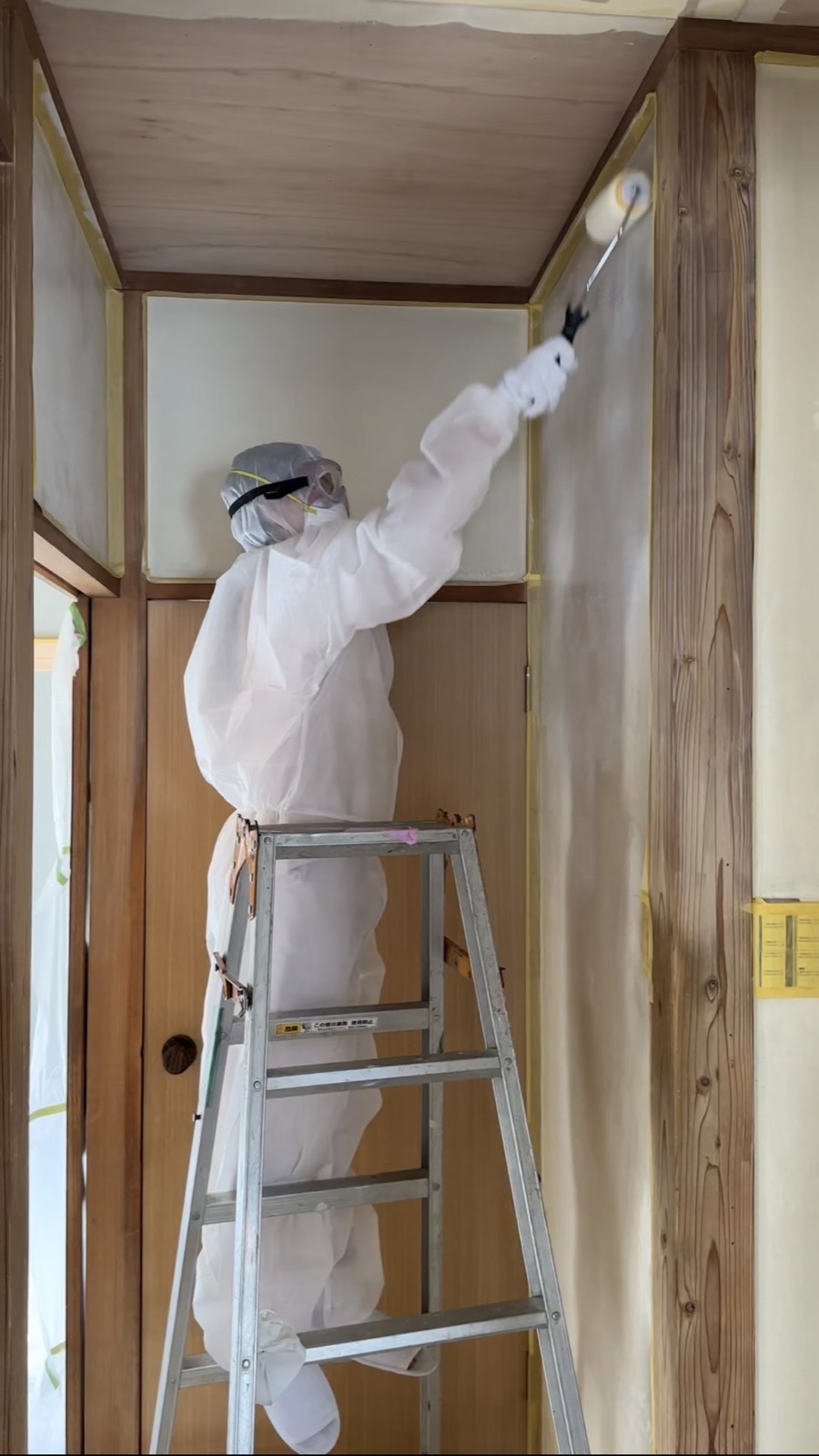
It ages beautifully, too. Unlike vinyl or paint, shikkui develops character with time. Small imperfections become part of the surface. It can be rewetted and repaired. In a hundred years, it will still be there.
My Washitsu
In the washitsu — the traditional Japanese room — of my akiya, I applied the shikkui myself. Every trowel pass on those walls was mine. It took much longer than I expected, and my arms ached in ways I didn’t know arms could ache, but finishing that room felt like completing a conversation with the house: I’m taking you seriously. I’m doing this properly.
I also did the wallpapering throughout the rest of the house, which gave me a different kind of respect for surface work — but nothing compared to the meditative difficulty of getting shikkui right.
Come and See It
You can look at photographs of shikkui walls online, but photographs flatten the surface and miss the way light moves across it at different times of day. The best way to understand what this material actually is — and what it does to a space — is to stand inside a room finished with it.
On the tour of my akiya in Tokyo, you’ll spend time in the washitsu I plastered myself, and I’ll be there to answer any questions about the process, the materials, and what it meant to me to restore this house this way.
Book the Akiya Tour on Airbnb Experiences →
Related reading: What is a tatami room? · What is a kominka? · The hidden costs of akiya restoration
Get the akiya cost breakdown we won't publish publicly
Join for renovation numbers, contractor lessons, sourcing notes, and behind-the-scenes updates from our Tokyo akiya.
Want the real akiya numbers, not just the pretty photos?
Subscribe for renovation cost breakdowns, contractor lessons, antique finds, and the next story before casual visitors see it.
No spam. Just the strongest restoration stories, real costs, and occasional tour news.